Search
The AI Memo
LOG IN
SIGN UP
HOME
Services
Podcast
Subscribe
Free ScoreCard
Search
Apr 13, 2026
trades-room-episode-1
trades-room-episode-1
00:00
12:57
Transcript
0:00
How many jobs did you lose last year? Not because your price was wrong, but because you were, uh, you were just too slow getting the estimate out. Oh, man. That is a painful question to ask. Right. But it's the reality.
0:13
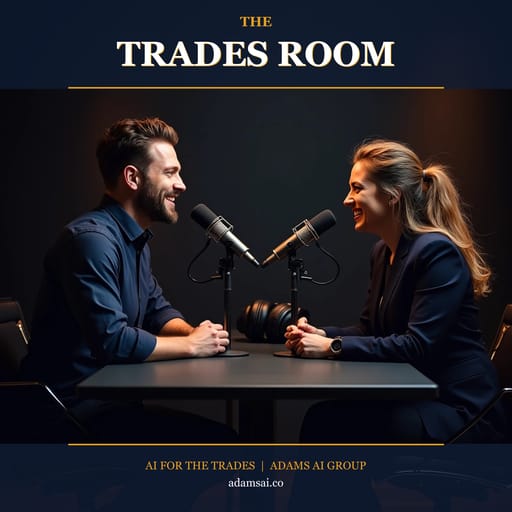
Welcome to the Trades Room, by the way. Today, we are doing a deep dive into this, um, this hidden, massive bottleneck in blue collar and trade businesses. Yeah.
0:23
And it's a bottleneck that I think a lot of owners just accept as a normal part of the job. Exactly. I mean, we always think of trade businesses as purely physical labor, right? Yep.
0:31
You picture turning the wrench, climbing the ladder, pouring the concrete. Getting your hands dirty. Yeah. But today, we're looking at a massive leaky pipe in the actual business operations itself. It's fascinating.
0:43
We are pulling from this really eye-opening article from The AI Memo. Mm-hmm. Uh, it's by Adams AI Group, published April 12th, 2026. And the title alone is just a gut punch. It really is.
0:54
It's titled, "Carlos Lost 40K in Plumbing Jobs Last Year. Not Because of Price." Forty thousand dollars. Yeah, just gone.
1:02
And so our mission today is really to look at how cutting edge AI is surprisingly solving these age-old problems in the trades.
1:11
Like, we're bridging the gap between those muddy boots on the job site and, you know, the giant stack of paperwork sitting in the back office. Which is usually just a kitchen table, if we're being honest. Right.
1:21
So let's unpack that. Let's talk about Carlos. How exactly does a guy with great skills and, uh, solid pricing lose 40 grand? Well, the article brings up this crucial statistic, and it really sets the stage.
1:33
They call it the 70% rule. Okay, what's that? Basically, when a customer is calling around for quotes, the very first contractor to send over a professional looking estimate wins the job about 70% of the time. Wow.
1:47
Seventy percent. Yeah. It's not a race to the bottom for the cheapest price. I mean, it's a race for speed and competence. That makes sense.
1:56
But let's break down the traditional workflow, because I think everyone listening knows this pain. You know, you're on the site taking notes on a scrap of paper. Or a napkin from the truck. Yeah.
2:04
Or trying to type it with dirty thumbs into your phone's notes app. Oh, yeah. And then what? You drive back to the office or, like you said, the kitchen table, and it's like eight at night. You're exhausted.
2:15
You just wanna eat dinner. Right. But you have to open up some clunky Word document and try to remember, wait, was it fifty feet of pipe or forty? And because you're tired, you put it off.
2:25
You say, "I'll do it in the morning." Which means it takes, what, one to two days to actually get that quote out? Easily. Mm. A lot of times it's forty-eight hours, and the financial drain of that delay is just...
2:37
It's staggering. Let's do the math on that. Okay, so think of it like this.
2:41
If you lose just two jobs a month, just two, because a competitor replied faster, and let's say those jobs average about five thousand dollars each. Okay, so that's ten thousand a month. Exactly. Ten thousand a month.
2:55
That is a hundred and twenty thousand dollars a year just walking right out the door. Mm. Over a hundred grand gone because you couldn't type fast enough at 8:00 PM.
3:04
Okay, but I have to push back on this a little bit because if the job is physical, like say I need my roof fixed, or I have a busted pipe, why is the paperwork speed the deciding factor?
3:15
Like, are customers really just that impatient? It's a fair question. I mean, if Carlos the plumber is the first guy in my driveway with a wrench, isn't that what matters? Well, yes and no.
3:25
If it's an absolute emergency, like water is actively flooding your living room. Right. You just hire whoever answers the phone. Exactly. Yeah.
3:31
But for the actual repair contract, the five thousand dollar job to fix the drywall and re-pipe the whole section, that goes out for bids. Ah, okay. And this is what the article points out so well.
3:42
The fast, quote, "psychologically signals to the customer that you have your act together." Oh, that makes a lot of sense. Think about the homeowner. They are stressed. Their house is a mess.
3:53
They feel totally out of control. They're freaking out. Right. So when a contractor sends over a clean, itemized professional PDF within, like, an hour, it just lowers their anxiety.
4:02
It tells them, "Hey, if this guy is this organized with his paperwork, he's probably gonna be organized when he's tearing apart my bathroom." So it's about signaling reliability. Hundred percent.
4:12
It's almost like if you take two days to send a quote, they subconsciously assume your tools are gonna be scattered all over their lawn for three weeks. Exactly. Speed is the new trust.
4:23
Amazon and Uber conditioned us for this. We expect things instantly now.
4:26
Okay, so that brings us to the two-minute AI fix because if the old way takes forty-eight hours and costs six figures and lost jobs, how are the smart competitors getting these quotes out in minutes?
4:39
This is where it gets really cool. I mean, they aren't hiring an administrative assistant to ride shotgun in the truck with them, right? No, but they kind of are, just a digital one.
4:48
The Adams AI Group article breaks down how modern competitors are using AI powered estimating tools right on their phones. On their phones. Yeah. It's incredibly simple.
4:59
You do the walkthrough on the job site, you snap a few photos of the problem area, and then you just describe the job using your voice. Like a voice memo. Exactly like a voice memo.
5:08
You just say, "Uh, I need fifty feet of half-inch copper pipe, two shutoff valves, and it's gonna be about four hours of labor." And the AI just figures it out. Yeah.
5:18
It instantly does the math, it pulls the current pricing, formats it into a professional document, drops the photos in, and literally sends it directly to the customer. Before you even put the truck in drive.
5:29
Before you even leave the driveway. That is insane. It really is like taking your entire back office administrative staff and just buckling them into the passenger seat of your truck. That's a great way to put it.
5:40
And the big takeaway here from Carlos's story is really important to highlight because when people hear AI in the trades, they panic a little. Right.
5:49
They picture, like, a Terminator robot showing up to install a water heater. Yeah, exactly. But it's not about humanoid robots turning wrenches. It's strictly about eliminating that paperwork bottleneck.
6:02
So you don't need to be a tech wizard. Not at all. You just need to know how to take a picture and talk into your phone. Yeah. Which everyone already does. Yeah. If you can send a text message, you can use this. Exactly.
6:12
Okay, so this is blowing my mind a little bit, but I have to wonder, is this just, like-An isolated thing? Is this just one tech-savvy plumber named Carlos figuring this out, or is this an industry-wide shift?
6:24
Oh, it is definitely an industry shift. The source material is very clear about this. The whole sector is waking up.
6:29
And they give some pretty compelling proof for that, looking at the twenty twenty-six trades calendar in Texas.
6:35
Yeah, Texas is massive for construction and trades right now, and the article highlights three major upcoming events where these exact conversations are taking center stage. Let's run through those. What's the first one?
6:48
First up is the Austin Build Expo. That's May twenty-seventh and twenty-eighth at the Palmer Event Center. Okay, Austin is booming. Booming.
6:56
And this expo is the premier event for construction and remodeling in Central Texas. The focus there is heavily shifting toward giving owners the tools to step out of the field.
7:05
Right, to work on the business rather than just drowning in it. Exactly. You go there to fix your operations. Okay, so that's Austin in May. What's next? Then we have the ASHRAE annual conference. Wait, ASHRAE?
7:16
Yeah, as in the American Society of Heating, Refrigerating and Air-Conditioning Engineers. That's the one. It's running June twenty-seventh through July first, also in Austin.
7:26
That's a huge, very technical, mechanical engineering crowd. It is. It's heavily aimed at HVAC and mechanical shops focusing on building automation. But here is the kicker from the article.
7:37
They have specific sessions dedicated to how AI and smart building tech are changing mechanical contracting. See, that is wild to me.
7:46
When a massive, historically conservative mechanical engineering conference dedicates stage time to AI, I mean, it tells you this isn't some Silicon Valley fad anymore. Right.
7:57
It's foundational to the future of blue-collar work. If ASHRAE is talking about it, you have to pay attention. You really do. Yeah. And it doesn't stop there. The third event they mention is the Houston Build Expo.
8:07
Oh, Houston, that's a beast of a market. The biggest construction market in Texas. That one's August twelfth and thirteenth at the NRG Center.
8:14
They have over two hundred and fifty exhibitors across residential, commercial, infrastructure, everything. And the money flowing through that room is just staggering. Totally.
8:23
And the through line for all of these events is efficiency. Everyone is realizing that if you can't process information quickly, you're gonna get crushed by the guy who can. Yeah.
8:32
But, you know, hearing all this, it brings up a real problem for the guys actually doing the work. What do you mean? Well, seeing AI at a trade show is one thing, right? You walk the floor, you nod, you take a brochure.
8:44
But how does a busy business owner actually implement this? Ah, right. Like, they can't just drop their current workload to become a software engineer. They're putting out fires all day.
8:55
That is the reality check of the whole situation. Most owners hear these buzzwords, AI, automation- But-... machine learning, and they just glaze over.
9:05
Because they have a crew that didn't show up, a truck with a flat tire, and a supplier who shorted them on materials. Exactly.
9:11
They simply don't have the time to figure it out while managing crews and keeping customers happy. But the danger is waiting just widens the gap. Because the leaks keep happening. Right. I mean, think back to Carlos.
9:23
If he lost forty grand just in the estimating phase- Mm-hmm... imagine the money leaking out of scheduling or dispatching or invoicing. Oh, man, the unpaid invoices because someone forgot to follow up. Exactly.
9:36
The administrative bleeding doesn't stop at the cold. So what's the solution? How do you plug the leak without shutting off the water completely? This is where the source article offers a really practical next step.
9:47
It's not about buying some massive, confusing software sort. The Adams AI Group offers what they call an AI readiness assessment. Okay, an assessment. How does that work? It's just a thirty-minute call.
10:00
It's free, no pressure. Basically, they look at your current operations, just how you do things day to day, and they pinpoint exactly where AI can be implemented this month to save time and money. Oh, I love that.
10:11
So it's essentially a diagnostic test for your business operations. That's a perfect way to look at it. It's like, okay, think about a mechanic.
10:18
When a truck comes in running rough, they don't just start ripping the engine apart. No, they'd go crazy doing that. They plug an OBDII scanner into the dashboard, right?
10:28
And the computer tells them, "Hey, cylinder three is misfiring." This assessment sounds like it does the exact same thing. It shows you exactly where your business is burning gas. Burning time, burning money, yes. Yeah.
10:39
It's finding that lowest hanging fruit. Maybe for one guy, it's the estimating. For another, it's just answering the phone when they're up on a roof. Right. Just fixing the one misfire first. Exactly.
10:50
You don't have to overhaul the whole engine. So let's recap this whole journey because I think this deep dive has been huge.
10:55
We started with Carlos, a guy who lost forty thousand dollars, and we learned that loss was caused by the clock, not the wrench. The kitchen table estimate is a killer. It really is.
11:07
But then we discovered that by just taking photos and talking into a phone, you can completely replace hours of that late night paperwork. It's an absolute game changer, and it's accessible right now. Yeah.
11:17
So for anyone listening, if you are running a business or even if you just know someone who is busting their back trying to keep a trade business afloat, you really should check this out. Hundred percent.
11:28
You can go to adamsai.co. They have a free weekly newsletter, The AI Memo, which is built specifically for people who build things. No Silicon Valley jargon. Right. Just practical nuts and bolts stuff.
11:43
And you can take two minutes to book that free AI readiness assessment. The link is book.adamsai.co/aireadinessassessment. Definitely worth thirty minutes of your time to see where you're losing money. Absolutely.
11:58
Well, this brings us to the end, but I wanna leave everyone with a final thought, something to really chew on as you go back to the job site. Let's hear it.
12:05
We've been talking this whole time about how AI tools are gonna completely level the playing field, right? Soon, every contractor is gonna be able to send a flawless instant estimate before they even leave the driveway.
12:15
Yeah, speed is gonna be the baseline. Exactly. So my question is, when that happens, what becomes the ultimate competitive advantage for local businesses in the next five years? Oh, that's a great question.
12:27
If the paperwork is perfect for everyone and the speed is guaranteed, how will you stand out? It kind of feels like once the digital side is entirely solved, the only thing left to compete on is the human element.
12:39
The actual craftsmanship. The craftsmanship, the handshake, the trust you build when you look a homeowner in the eye and say, "I've got this." It forces you to be better at the actual job. Exactly.
12:49
Something to think about. Thank you all for joining us on this deep dive into the trades room. We will see you on the next one. Catch you later.
The Trades Room
Recent episodes
No results found